SpaceX, OpenAI and Anthropic: Are Investors Buying Products or Promises?
The investment community may soon face one of the largest tests of market discipline in recent memory. Several of the world’s most talked-about technology companies are expected to seek public listings, and together they represent a staggering amount of value being assigned to businesses whose futures remain largely unwritten.
What makes this situation unique is not simply the size of the offerings. It is the fact that investors are being asked to value technologies that, in many cases, have not yet achieved the scale required to justify their projected worth.
Expand to view estimated mega IPO valuation comparison
| Company | Primary Market Narrative | Estimated Valuation Range |
|---|---|---|
| SpaceX | Launch services, Starlink, space infrastructure, AI-linked future applications | $1.75T – $2.3T |
| Anthropic | Enterprise AI, frontier models, AI infrastructure demand | Approx. $965B – $1.0T+ |
| OpenAI | Consumer AI, enterprise AI, platform economics, model leadership | Approx. $850B – $1.0T |
| Combined | Future technology priced at historic scale | Approx. $3.5T – $4.0T+ |
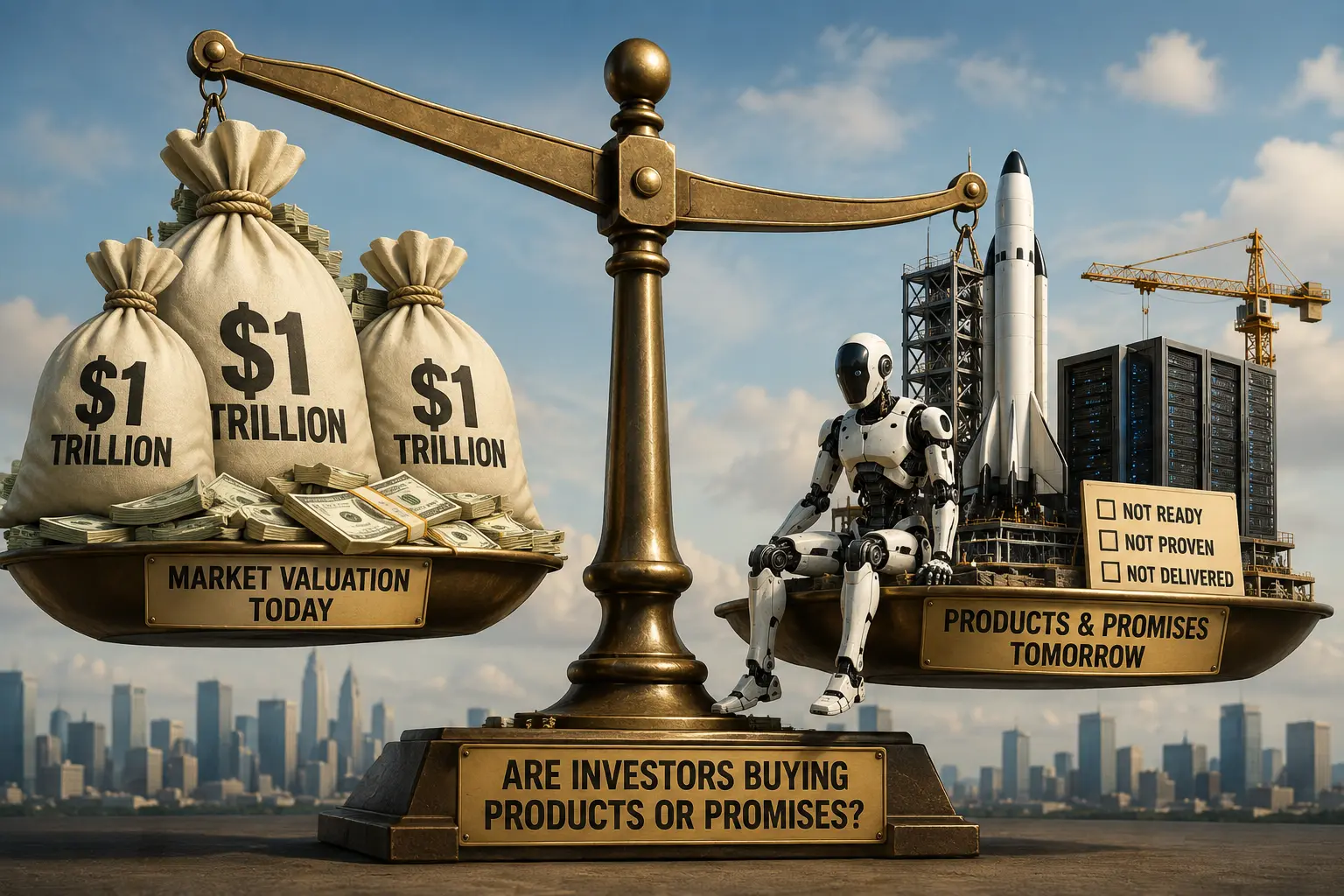
Historically, investors purchased shares of companies based on revenue growth, profit margins, market share, and predictable business execution. Today’s environment appears different. Valuations are increasingly tied to future possibilities rather than current performance.
SpaceX is perhaps the most visible example. The company operates a successful launch business and has built StarlinkA satellite internet constellation operated by SpaceX providing global broadband coverage. into a meaningful communications platform. Those accomplishments are significant and difficult to dismiss. However, a substantial portion of the company’s valuation appears to be based on expectations that have not yet materialized.
Investors are assigning value to future space infrastructure, future transportation systems, future AI integration, and future planetary expansion initiatives. Whether those opportunities eventually become reality is almost beside the point. The question investors must answer today is how much those possibilities should be worth right now.
The same challenge exists with OpenAI and Anthropic. Both companies sit at the center of the artificial intelligence revolution. Demand for AI infrastructure continues to accelerate, and memory suppliers such as Micron, SK Hynix, and Samsung have benefited from the surge in demand for high-bandwidth memory.
GetFlashMemory.info recently discussed this broader market behavior in Micron Briefly Crosses $1 Trillion Valuation as AI Memory Demand Explodes, where AI demand helped push memory-related valuations into historic territory. We also noted in Memory Stocks Are Rallying, But the Market Is Pricing a Longer Shift that the market is increasingly rewarding companies not only for what they sell today, but for what investors believe they may control tomorrow.
That is the important distinction. Investors are no longer simply evaluating existing businesses. They are evaluating narratives.
One narrative suggests humanoid robots will become a multi-trillion-dollar industry. Another suggests fully autonomous vehicles will replace traditional transportation. Yet another assumes artificial intelligence platforms will become the operating systems of the future economy.
These outcomes are possible. They are not guaranteed.
The challenge becomes more apparent when examining timelines. Tesla’s Cybertruck eventually entered production, but years later than originally anticipated. Fully autonomous driving remains a work in progress despite repeated forecasts suggesting widespread deployment was just around the corner. Meanwhile, competitors such as Waymo have demonstrated commercial driverless operations in multiple cities.
This does not necessarily mean Tesla, SpaceX, OpenAI, or Anthropic will fail to deliver future products. It does suggest that investors should distinguish between technological possibility and commercial reality.
History shows that breakthrough technologies often arrive later than expected while attracting investment much earlier than justified.
The memory industry has experienced similar cycles. NAND flash manufacturers have repeatedly gone through periods where expectations exceeded demand, only to see valuations reset when reality failed to match forecasts. Eventually the technology matured, adoption increased, and growth resumed. Investors who confused timing with inevitability often paid the highest price.
A similar risk may exist today.
The market may ultimately prove correct about AI, humanoid robots, autonomous vehicles, and space infrastructure. These technologies could become foundational industries over the next several decades. However, the question facing investors is not whether these technologies will exist.
The question is whether trillion-dollar valuations should be assigned before the products achieve mass-scale commercial deployment.
That distinction matters.
Investing in future technology has always required optimism. Successful investing, however, also requires discipline. When valuation becomes disconnected from execution timelines, investors are no longer purchasing proven businesses. They are purchasing confidence.
Confidence can be extraordinarily valuable.
It can also be extraordinarily expensive.
Conclusion
The upcoming IPOs from SpaceX, OpenAI, and Anthropic may ultimately prove successful investments. The technology behind each company is real, and each organization has demonstrated meaningful innovation within its respective market.
However, investors should recognize the difference between technological achievement and valuation discipline.
A recurring theme throughout technology history is that transformative products often arrive later than expected, cost more than anticipated, and take longer to achieve mass-market adoption than early projections suggest. Yet capital markets frequently price these outcomes as if success were already guaranteed.
SpaceX provides a useful example. The company has undeniably achieved milestones that many considered impossible. At the same time, several of the future growth drivers contributing to today’s valuation – including widespread robot deployment, fully autonomous transportation, large-scale space infrastructure, and interplanetary expansion – remain largely unproven as commercial businesses.
The same observation can be applied to today’s AI leaders. Investors are not simply buying current revenue streams. They are purchasing expectations of future dominance.
That distinction matters.
When valuations approach or exceed one trillion dollars before the underlying products have reached broad commercial maturityThe stage at which a technology or product achieves stable market adoption and predictable revenue generation., the investment thesis begins to rely less on execution and more on belief. Markets can support belief for surprisingly long periods, but history repeatedly demonstrates that belief is not the same as delivered results.
The technology may eventually justify the valuations.
The risk is that investors are paying tomorrow’s price today.
If that proves true, these IPOs may be remembered less as historic investment opportunities and more as examples of how enthusiasm can outrun commercial reality.