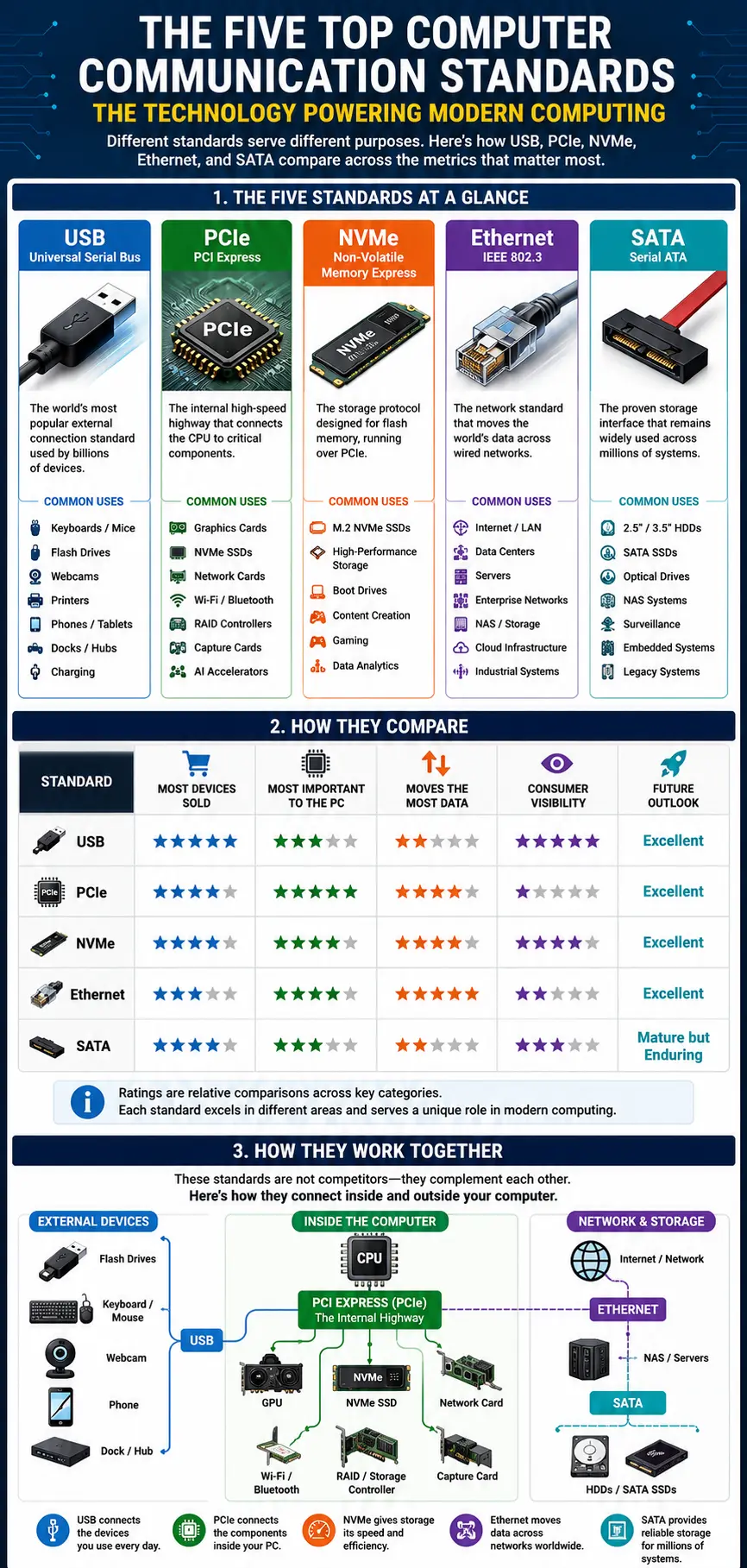
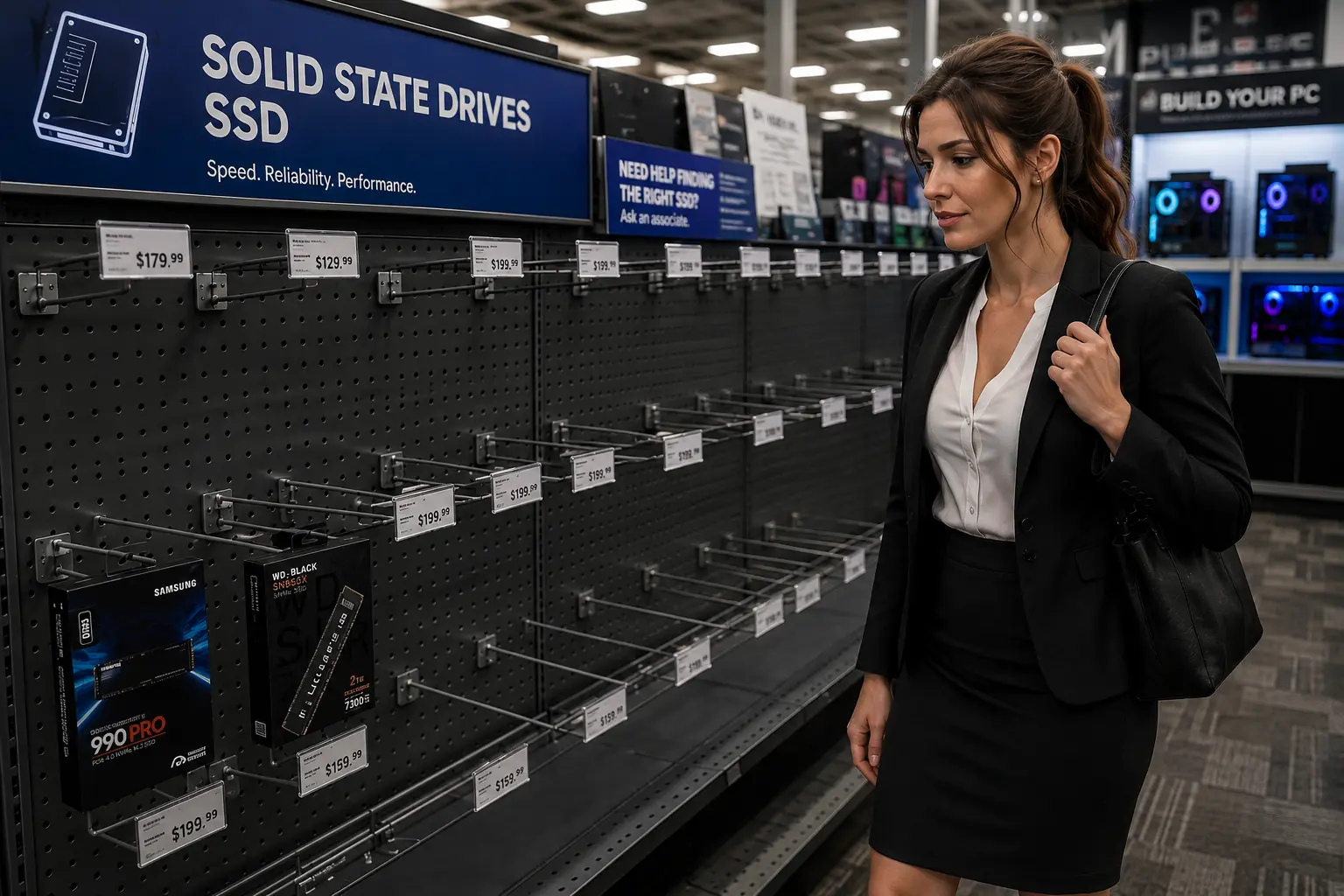
I think this is where the story gets really interesting, because there are actually three separate markets that most people simply lump together as “flash memory.”
Consumer SSDs
Samsung 990 Pro, WD Black, Crucial, Kingston…
Enterprise SSDs
U.2, E3.S, PCIe Gen5 drives going into AI servers.
Raw NAND
The memory chips themselves.
Here’s the important part.
Every one of those products starts from the same silicon wafers.
Once you understand that, the entire SSD market suddenly makes a lot more sense.
AI Companies Aren’t Buying Samsung 990 Pros
This is probably the biggest misconception.
OpenAI isn’t ordering pallets of Samsung 990 Pro drives from Amazon.
Meta isn’t filling shopping carts with WD Black SSDs.
Google isn’t calling Amazon asking for 10,000 Crucial consumer drives.
That’s not how AI infrastructure gets built.
They’re buying thousands of complete AI servers from OEMs like Dell, Supermicro, HPE, Lenovo, along with ODM manufacturers in Taiwan.
Those servers need enterprise SSDs.
Those enterprise SSDs need NAND flash.
The same NAND flash that could have ended up inside a Samsung 990 Pro, WD Black, Crucial, or Kingston consumer SSD.
Same NAND.
Different customer.
NAND Production Isn’t Infinitely Expandable
Suppose Samsung has enough fabrication capacity this month to produce 100 million NAND dies.
Those dies could become:
- Retail SSDs
- Enterprise SSDs
- Embedded phone storage
- Automotive storage
- Industrial storage
But only once.
Every NAND die can only become one product.
Manufacturers can’t simply press a button and double production because demand suddenly increases. Building new fabrication capacity takes years and billions of dollars.
When demand shifts faster than manufacturing capacity, companies don’t create more NAND.
They simply decide where the existing NAND goes.
AI Changes Profitability
This is where accounting takes over.
Imagine these numbers. They’re only examples to illustrate the point.
Consumer SSD
Profit:
$12
Enterprise SSD
Profit:
$150
HBM Memory
Profit:
$400
Now imagine you’re Samsung.
Which product gets the wafer?
It’s a pretty easy boardroom decision.
Enterprise SSD Demand Has Exploded
Think about a single AI server.
An 8-GPU workstation?
Maybe several SSDs.
A rack?
Dozens.
An AI cluster?
Hundreds.
A hyperscale data center?
Thousands.
A brand-new AI campus?
Tens of thousands.
Now multiply that by companies building AI infrastructure simultaneously.
Microsoft.
Google.
Meta.
Amazon.
Oracle.
CoreWeave.
OpenAI.
xAI.
Every one of them is expanding at the same time.
This isn’t a normal enterprise refresh cycle.
It’s a synchronized global infrastructure build-out.
Retail Gets Whatever Is Left
This is the part consumers actually experience.
The retail SSD market isn’t necessarily being cut off.
It’s simply no longer first in line.
Imagine a bakery.
They bake 10,000 loaves of bread every morning.
For years, 8,000 loaves went to local grocery stores.
Then one day a national hotel chain walks in and says:
We’ll buy 7,000 loaves every day for the next five years.
What happens?
The grocery stores don’t suddenly have empty shelves.
Instead they notice:
- Fewer brands
- Fewer discounts
- Fewer specialty products
- Occasional shortages
Sound familiar?
That’s very similar to what’s happening in the SSD market today.
Enterprise Storage Is a Different Business
Another thing people rarely talk about is profit margins.
Consumer SSDs are incredibly competitive.
Margins are thin.
Enterprise storage isn’t.
Enterprise customers aren’t simply buying hardware.
They’re buying:
- Firmware validation
- Endurance guarantees
- Encryption
- Support contracts
- Availability guarantees
- Replacement logistics
The SSD itself is only one part of the overall sale.
That makes enterprise business dramatically more attractive than selling discounted 2 TB gaming SSDs during Black Friday.
AI Is Changing the Mix of NAND
Here’s something I don’t think the industry has fully appreciated yet.
The AI boom isn’t simply increasing NAND demand.
It’s changing where the world’s NAND ends up.
Historically, a huge percentage of NAND production went into smartphones.
A large portion went into PCs.
Some went into enterprise storage.
Today, enterprise storage is growing much faster than the consumer PC market.
Even if total NAND production increases, a larger percentage of that output is now being directed toward enterprise products because that’s where both demand and profitability are strongest.
That’s a structural shift.
Not just another temporary shortage.
AI Didn’t Cause an SSD Shortage
I think that’s actually the wrong way to describe what’s happening.
A better way to say it is this:
AI promoted enterprise storage to first-class status. Consumer storage became the secondary market.
That’s an important distinction.
The fabs aren’t saying,
We don’t want consumers anymore.
They’re saying,
We have one wafer, a long list of customers, and the companies building AI infrastructure are placing larger orders, signing longer contracts, and paying higher prices.
That’s how allocation decisions get made.
The Bigger Question
Understanding why the retail SSD market has changed is only half the story. The next challenge is understanding the scale of that change.
How much NAND flash does a modern AI data center actually consume? Not GPUs—storage. How many petabytes of flash are required to support a 100,000-GPU AI campus? How many NAND wafers does that represent? Could a single hyperscale AI deployment consume as much flash memory as millions of consumer SSDs?
Those aren’t easy questions to answer because cloud providers rarely publish detailed storage figures. Yet they’re probably the most important questions in the entire discussion. If we can quantify where the world’s NAND is actually going, we’ll move beyond the simplistic headline that “AI is making SSDs more expensive.”
Instead, we’ll have a much clearer picture of how artificial intelligence is reshaping the global flash memory industry. My suspicion is that we’re not witnessing another temporary supply shortage at all. We’re watching the world’s NAND supply being redirected toward a completely different class of customer. If that’s true, then today’s retail SSD market isn’t experiencing a passing disruption—it’s adapting to a new reality.
Author’s Note / E-E-A-T: This article is based on industry experience in flash memory, USB storage, duplication systems, and NAND-based product markets. GetFlashMemory.info focuses on explaining flash memory trends, supply chain behavior, storage technology, and market changes in practical terms for readers who want to understand what is happening behind the retail shelf.