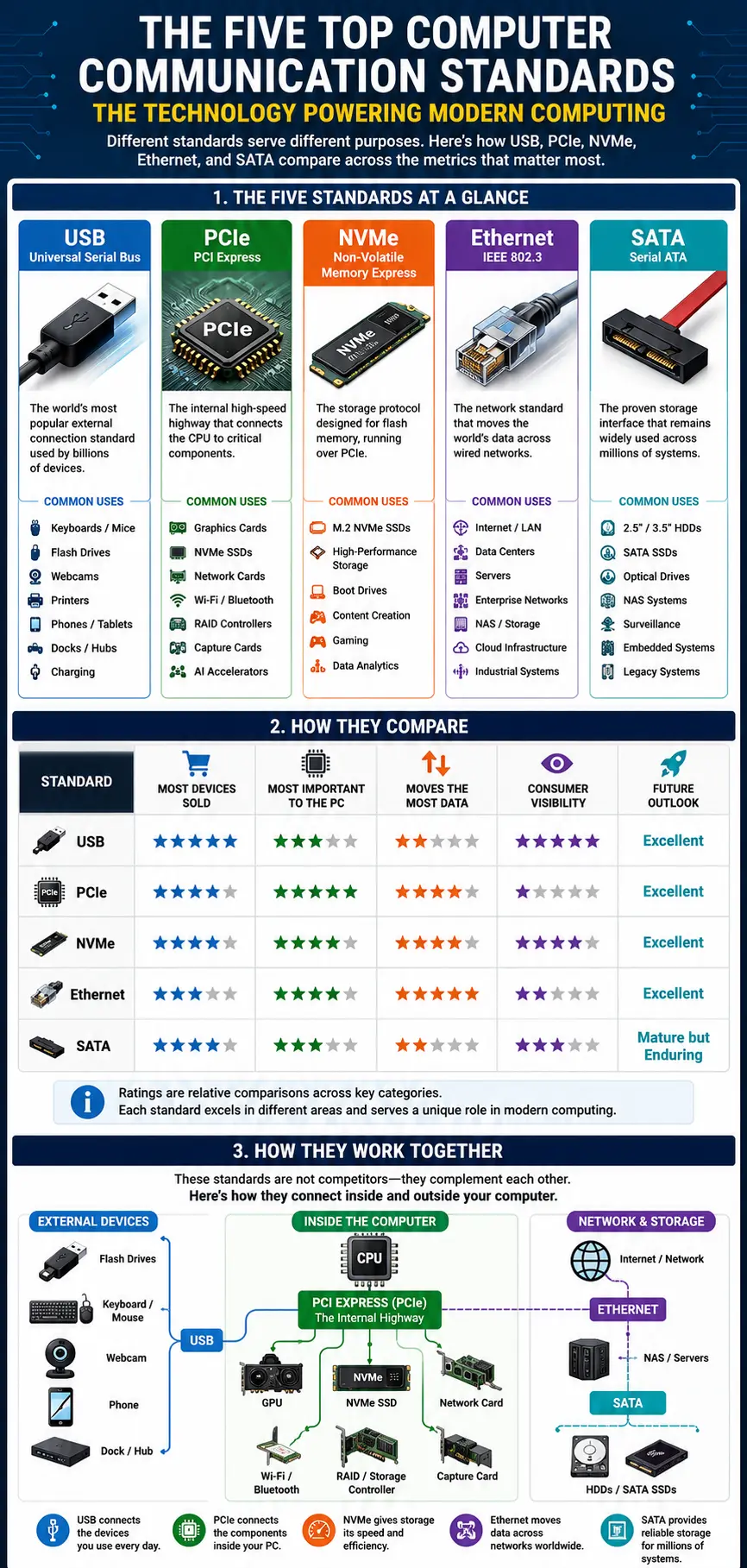
Click the infographic to view the full-size version
How USB, PCIe, NVMe, Ethernet, and SATA Quietly Power Modern Computing
When someone asks what the most important communication standard in a computer is, the answer is not as obvious as it sounds. Most people immediately think of USB because they plug something into it every day. Others might say NVMe because nearly every new SSD seems to advertise those four letters. Engineers may argue for PCI Express, while network administrators would probably vote for Ethernet.
The truth is that everyone may be right, depending on what they are measuring.
Some communication standards dominate because billions of devices use them. Others move an overwhelming amount of the world’s data. A few rarely receive public attention even though modern computers could not function properly without them.
Instead of trying to crown one absolute winner, it is more useful to examine these technologies from several different perspectives: which standard appears in the most products, which one is most important inside the computer, which one moves the most data, and which standards are likely to remain important in the years ahead.
If We Ranked by Devices Sold
USB wins this contest by an enormous margin.
Desktop computers, laptops, tablets, smartphones, printers, webcams, keyboards, mice, USB flash drives, docking stations, barcode scanners, security keys, digital cameras, game controllers, and countless embedded products depend on USB. The standard has become so universal that many people no longer think about it as a technology. It simply works, whether the connector is USB-A, Micro USB, or today’s increasingly common USB-C. That widespread acceptance reflects how one early USB design choice helped change the direction of technology.
USB also reaches well beyond traditional computer peripherals. The interface is now used for charging, video output, networking, audio, device management, firmware updates, and high-speed storage. A single USB-C port may perform several of those jobs, although the exact capabilities still depend on the computer, cable, controller, and device.
When billions of products ship with some form of USB connection, few other computer communication standards can compete in terms of sheer unit volume and everyday visibility.
That popularity sometimes creates the impression that USB must also be the most important interface inside the computer.
It is not.
If We Ranked by Importance Inside the Computer
That title belongs to PCI Express.
PCI Express, better known as PCIe, is the internal highway connecting many of the highest-performance components in a modern computer. Graphics cards communicate over PCIe. NVMe SSDs use PCIe. High-speed networking cards use PCIe. AI accelerators, RAID controllers, USB controllers, capture cards, storage adapters, and many other expansion devices also depend on it.
PCIe is not normally something the average user plugs in every morning. It operates beneath the surface, moving information between the processor, chipset, memory-related devices, storage hardware, graphics hardware, and peripheral controllers.
Even a USB device may depend indirectly on PCIe. The flash drive or webcam connects through USB, but the computer’s USB host controller may communicate with the rest of the system over PCI Express.
Without PCIe, modern computing as we know it would look very different. It is arguably the most important computer communication standard that most users never think about.
The Protocol Everyone Talks About: NVMe
NVMe has become one of the most recognized names in storage technology, but it is also one of the most frequently misunderstood.
Many buyers assume NVMe replaces PCIe. It does not.
PCIe is the transportation system. NVMe is the storage communication protocol operating over that transportation system.
Think of PCIe as an interstate highway. NVMe is the language and rulebook that allows the storage device and computer to communicate efficiently while traveling on that highway. One provides the path for moving information, while the other defines how storage commands are organized, submitted, completed, and reported.
This distinction is important because PCIe is not limited to storage. A graphics card can use PCIe without using NVMe. A networking adapter can use PCIe without using NVMe. NVMe was designed specifically for nonvolatile memory storage, particularly the low-latency parallel characteristics of modern NAND flash.
NVMe replaced much of the command overhead inherited from older storage technologies. Instead of treating a solid-state drive like a faster mechanical hard drive, NVMe was designed around the reality that flash storage can process many operations simultaneously.
That is one reason NVMe SSDs can deliver dramatically higher performance than older storage devices without requiring an entirely separate internal transportation system. The practical improvement depends on the computer and workload, but the performance difference explains how much an SSD can speed up a computer compared with older storage technology.
The Quiet Giant: Ethernet
If USB dominates consumer electronics, Ethernet dominates professional computing infrastructure.
Data centers, enterprise server rooms, cloud providers, financial institutions, universities, factories, hospitals, government networks, and corporate offices rely heavily on Ethernet. Even though Wi-Fi has reduced the number of visible network cables in many homes, the Internet itself still depends extensively on wired Ethernet infrastructure.
A wireless device does not remain wireless for its entire journey across the Internet. At some point, its traffic usually enters a wired network connected to switches, routers, servers, storage systems, and data-center infrastructure.
Much of the world’s digital information eventually travels across Ethernet links during some portion of its journey.
Ethernet may not win when counting the number of cables attached directly to consumer laptops, but it becomes much harder to challenge when measuring enterprise deployment, network capacity, server connectivity, and the total amount of data moving between computer systems.
Consumers may not think about Ethernet as often as they once did, but businesses, cloud providers, and data centers certainly do.
The Veteran That Refuses to Disappear
Before NVMe became the preferred choice for high-performance solid-state storage, there was SATA.
SATA transformed computer storage by replacing older parallel ATA connections with a smaller, simpler, and faster serial interface. It became the standard connection for desktop and laptop hard drives, optical drives, several generations of solid-state drives, and specialized products such as SATA flash modules used in compact systems.
NVMe now offers substantially greater performance, but SATA continues to serve millions of desktop computers, industrial systems, embedded devices, surveillance recorders, network storage appliances, backup systems, removable drive bays, and traditional hard drives.
Technology enthusiasts sometimes dismiss SATA as yesterday’s interface. The market tells a more complicated story.
Many applications do not require NVMe performance. A surveillance system recording several camera streams, a desktop used for office work, or a network appliance storing archived files may gain very little practical benefit from replacing every SATA device with a faster and potentially more expensive NVMe alternative.
SATA products continue shipping because the technology is mature, dependable, widely supported, and inexpensive. Sometimes an older interface remains successful precisely because manufacturers and system builders understand it so well.
Comparing the Five Standards
No public industry report can produce a completely objective ranking because these standards perform different jobs. USB device shipments cannot be compared directly with Ethernet traffic volume, and NVMe adoption cannot be separated entirely from PCIe because NVMe storage normally depends on PCI Express.
However, the following comparison provides a useful practical view of how the five standards fit into modern computing. The star ratings are relative assessments rather than audited sales totals.
Expand the communication standards comparison
| Standard | Devices Sold | Importance to the PC | Data Movement | Consumer Visibility | Technology Outlook |
|---|---|---|---|---|---|
| USB | ★★★★★ | ★★★☆☆ | ★★☆☆☆ | ★★★★★ | Excellent |
| PCI Express | ★★★★☆ | ★★★★★ | ★★★★☆ | ★☆☆☆☆ | Excellent |
| NVMe | ★★★★☆ | ★★★★☆ | ★★★★☆ | ★★★★☆ | Excellent |
| Ethernet | ★★★☆☆ | ★★★★☆ | ★★★★★ | ★★☆☆☆ | Excellent |
| SATA | ★★★★☆ | ★★★☆☆ | ★★☆☆☆ | ★★★☆☆ | Mature but enduring |
It Depends on What We Measure
Trying to identify the single most important communication standard is a little like asking whether highways, airports, railroads, or shipping ports matter most to a country’s economy. Each one answers a different transportation problem.
If we are measuring the number of products shipped and the number of people interacting with the interface, USB stands alone.
If we are measuring the internal foundation of modern computers, PCI Express is difficult to challenge.
If we are measuring the transformation of solid-state storage, NVMe has changed how computers communicate with flash memory.
If we are measuring enterprise networking, cloud infrastructure, and the movement of information between systems, Ethernet carries an extraordinary portion of the world’s digital traffic.
If we are measuring longevity, installed equipment, and continued deployment, SATA continues to demonstrate that older technology does not immediately become obsolete simply because something faster arrives.
These standards do not compete with one another in quite the way product marketing sometimes suggests. Instead, they work together. A computer might load information from an NVMe SSD over PCIe, send it through a USB controller to an external device, or transfer it across an Ethernet network to another system. A SATA drive may then store the backup.
Each standard occupies a different layer of the computing environment.
Most Popular, Most Important, or Most Needed?
Based on visibility and product volume, USB is the most popular.
Based on internal system importance, PCIe is probably the most necessary.
Based on modern storage performance, NVMe is the most influential.
Based on the amount of information carried between computers and data centers, Ethernet may be the largest mover of data.
Based on endurance and installed infrastructure, SATA remains one of the most persistent.
This is why any ranking that simply lists USB first, NVMe second, and PCIe third can be misleading. NVMe depends on PCIe, USB frequently connects through a PCIe-based host controller, and Ethernet may move more total information than either of them once global network infrastructure is considered.
One Last Point
Perhaps the most interesting observation is that consumers tend to recognize the names printed on the outside of a computer while overlooking the technology working quietly inside it. USB receives attention because people plug something into it every day. NVMe receives marketing attention because SSD manufacturers print it prominently on product packaging.
Yet beneath both often sits PCI Express, carrying traffic between processors, storage, networking, graphics, USB controllers, and countless other devices without asking for much recognition.
The most important communication standard in your computer may be the one you have almost never noticed.
Editorial note: This comparison evaluates the practical role, visibility, deployment, and importance of major computer communication standards. The star ratings are editorial comparisons intended to show relative strengths across different categories. They should not be interpreted as audited shipment totals or direct measurements from a single industry report.