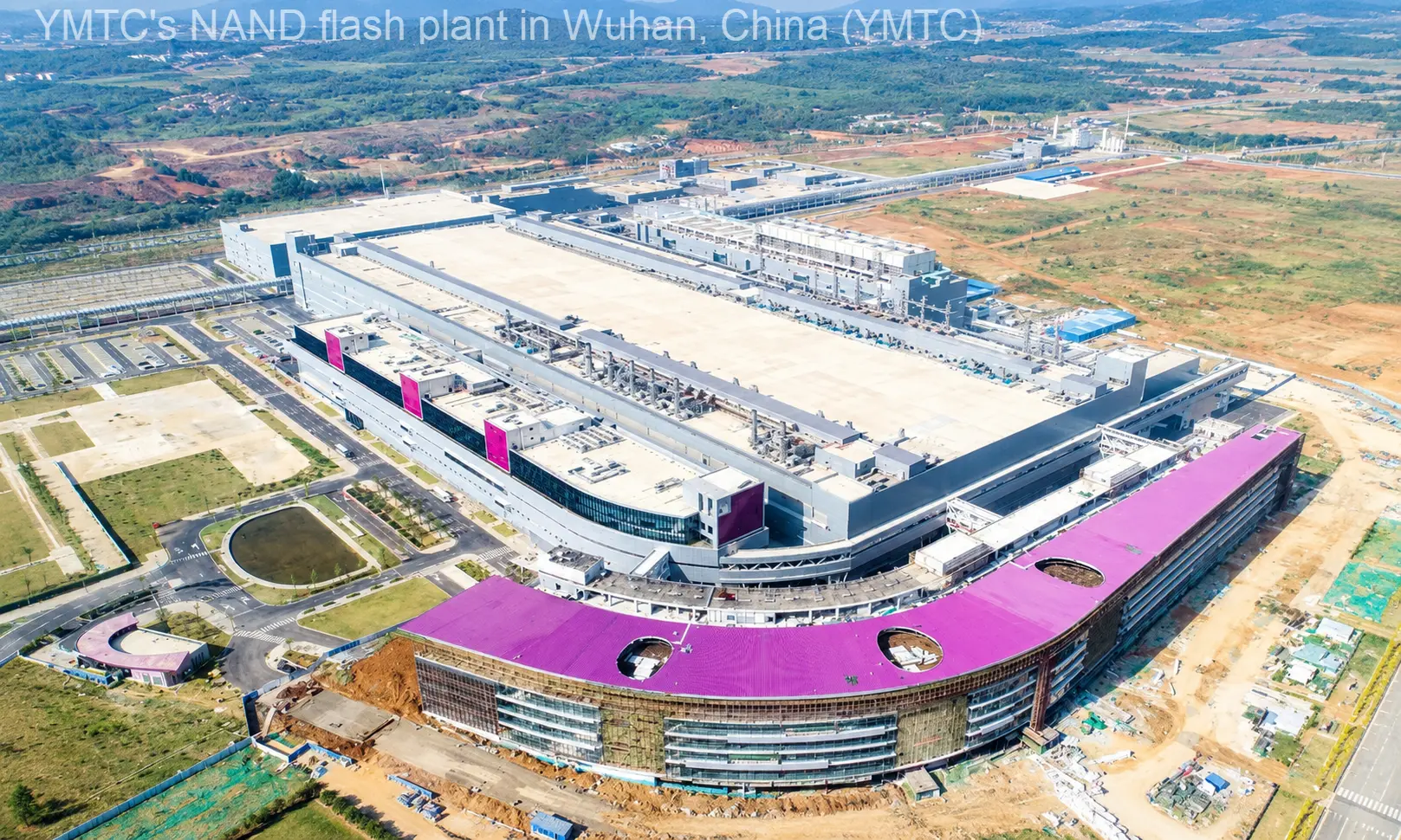
YMTC has become a legitimate global NAND competitor and the most striking number is the market-share progression which can be seen from the table below. Let’s start off today’s conversation with the table. Take a look:
| NAND revenue share | Q1 2025 | Q1 2026 |
|---|---|---|
| Samsung | 31% | 29% |
| SK hynix/Solidigm | 16% | 18% |
| Kioxia | 17% | 14% |
| Micron | 15% | 13% |
| SanDisk | 13% | 13% |
| YMTC | 8% | 13% |
That isn’t Barron’s estimating. Those are Counterpoint’s published numbers. YMTC went from clearly being the small Chinese player to essentially being in a four-way tie with Micron, SanDisk and Kioxia. Counterpoint says YMTC’s revenue grew roughly 445% year over year.
And there is already evidence the story has moved further. A report last week citing Q2 shipment data puts YMTC at roughly 14% and third place, although I would treat that as a different measurement because it’s shipment share rather than Counterpoint’s Q1 revenue-share table.
So the trajectory is real.
But here’s the crazy part of the IPO
The company being listed is technically CCSH Corporation, YMTC’s parent, although YMTC generates more than 90% of the group’s revenue. It wants to raise about 33 billion yuan, or $4.9 billion, and the proposed valuation works out to roughly 275-330 billion yuan, approximately $41-$49 billion.
The money isn’t simply being raised to cash out shareholders. The filing says proceeds are intended for production-line upgrades and R&D for advanced storage technologies.
That’s what we should pay attention to.
YMTC already got from 8% to 13% while dealing with U.S. technology restrictions. Now potentially give it another $4.9 billion to improve yield, increase capacity, develop newer NAND and further localize its equipment supply chain.
Counterpoint actually makes a pretty strong prediction: if YMTC gets the additional IPO capital and scales successfully, it expects YMTC to surpass both Kioxia and Micron and establish itself as the world’s No. 3 NAND supplier.
That’s considerably stronger than the Barron’s article makes it sound.
There is another important number buried in this story
The entire NAND market has gone nuts.
Counterpoint says Q1 2026 NAND revenue reached approximately $46 billion.
That’s:
+90% quarter over quarter
+250% year over year (3.5x)
And enterprise SSDs already accounted for 43% of NAND revenue, with Counterpoint forecasting them to exceed 60% by the end of 2026.
That connects directly to what we’ve been talking about with the current flash-memory market. This isn’t primarily smartphones suddenly consuming vastly more flash. AI infrastructure is pulling NAND upstream into servers and enterprise SSDs.
That changes the economics for everybody downstream buying ordinary NAND.
And this is where Micron’s HBM strategy becomes interesting
Barron’s is right that YMTC isn’t an existential Micron problem because Micron isn’t primarily a NAND company.
Micron has a much more attractive battlefield right now: HBM and AI DRAM.
At Hot Chips yesterday, Micron was talking about what it calls the worsening “memory wall.” Compute capability is increasing faster than memory bandwidth can feed it, making memory itself one of the limiting factors in AI systems.
And this has a strange side effect for the ordinary memory market.
As the Barron’s article notes, HBM consumes roughly three times as much wafer capacity as conventional memory for a comparable amount of memory capacity.
So Micron, Samsung Electronics and SK hynix have a very powerful economic incentive to dedicate manufacturing resources to expensive AI memory instead of commodity memory.
That effectively removes capacity from the conventional market.
AI demand doesn’t merely consume more memory. It changes what memory manufacturers want to manufacture.
I think that’s one of the most important things happening in memory right now.
And YMTC creates an interesting counterforce
This is where I think the story gets particularly relevant to NAND and flash products.
You essentially have two forces pulling in opposite directions.
On one side:
AI → enterprise SSD demand → NAND shortage → higher NAND pricing
plus:
AI → HBM demand → manufacturers allocate resources toward high-margin AI memory → less conventional memory supply
But now you have:
China → YMTC expansion → billions in new manufacturing investment → potentially much more NAND supply
The first two are inflationary for NAND.
The third is eventually deflationary.
And the timing could be fascinating.
YMTC’s filing itself acknowledges the possibility of NAND oversupply in 2027.
That wouldn’t surprise me at all.
Memory has historically done this repeatedly. Shortage causes prices to explode. Exploding profits encourage capacity expansion. Everyone expands around the same time. Demand growth eventually slows or supply catches up.
Then suddenly:
“Where did all this NAND come from?”
And prices collapse.
There’s also a geopolitical wrinkle
YMTC remains constrained by U.S. trade restrictions. The IPO filing specifically identifies its presence on U.S. trade/military restriction lists as a risk.
But something interesting has happened as a consequence: YMTC has been working to reduce dependence on U.S. manufacturing technology, including greater use of domestically sourced semiconductor equipment and simplified manufacturing processes.
That makes the long-term story bigger than YMTC.
If China successfully develops a largely domestic NAND manufacturing ecosystem, export controls stop being quite as powerful.
They may slow Chinese semiconductor development without permanently stopping it.
And $4.9 billion provides quite a bit of money to work on that problem.
For Micron, I wouldn’t interpret today’s stock drop as “YMTC is killing Micron”
The Barron’s headline makes that connection easy to make, but the evidence doesn’t really support it.
Micron fell today during a broader technology-sector selloff, and YMTC directly competes with only the NAND portion of Micron’s business.
Micron’s real competitive fight over the next few years is much more likely:
Micron vs. SK hynix vs. Samsung in HBM.
If Micron stays technologically competitive there, YMTC taking another few points of NAND share is annoying but manageable.
If Micron falls behind in HBM, that would concern me far more.
Meanwhile, YMTC is rapidly becoming a much bigger problem for Samsung, Kioxia, SanDisk and SK hynix’s NAND business, because those companies have considerably more exposure to the NAND market.
One other thing jumped out at me
Look at this progression:
Q1 2025: YMTC 8%
Q2: 9%
Q3: 10%
Q4: 11%
Q1 2026: 13%
That’s remarkably consistent share capture.
It doesn’t look like one lucky quarter.
And now they’re raising $4.9 billion.
For someone watching the flash-memory industry rather than simply watching Micron stock, that is the real story.
I could very easily see the next chapter being something like:
2026: NAND shortage / extraordinary pricing
2027: YMTC capacity ramps + incumbent capacity responds
2027-28: NAND supply catches demand and commodity pricing gets ugly again
Not guaranteed, of course. AI storage demand could remain strong enough to absorb it. But we’re beginning to see the ingredients for the next classic NAND cycle.
And there is actually a very good GFM article hiding in this, because the interesting angle isn’t “YMTC files IPO.” It’s “The NAND Shortage Is Creating the Company That Could Eventually End It.” That connects the current AI-driven shortage, YMTC’s 8→13% rise, the $4.9B expansion war chest, and the possibility of 2027 oversupply into one story rather than simply repeating today’s financial news.