USB 3.0 Chipsets to boost Genesys and Alcor Revenues

AlcorIC design houses Genesys Logic and Alcor Micro are expected to see their revenues grow over 20% sequentially in the second quarter of 2010 buoyed by increasing shipments of USB 3.0 controller chips, according to industry sources. Genesys indicated that it has started shipping, in small volume, its second-generation USB 3.0-SATA bridge controllers, with the third-generation of its kind to be available in the third quarter of 2010. Overall, USB 3.0 chips will contribute over 3% to its total revenues in the second half. Meanwhile, industry sources indicated that Alcor Micro has landed orders for USB card reader controllers for LCD TV application from a major player in Korea, which will help drive up its USB controller shipments. Continue Reading

Nexcopy Announces New microSD Card Duplicator

Nexcopy Announces New microSD Card Duplicator

Today Nexcopy announced an all-new microSD card duplicator product line. Earlier SD duplicators required adapter cards for microSD media, which slowed down workflow. The new system eliminates adapters entirely, cutting unnecessary steps and boosting throughput. Nexcopy estimates production increases of up to 30% simply because users no longer have to seat microSD cards into adapters first.

microSD Card Duplicator

Every microSD Card Duplicator ships with Nexcopy’s Drive Manager software suite, known for its broad set of copy and management functions.

Copy Functions Built In

  • File Copy
  • Copy Add
  • IMG Copy
  • Unique Data Streaming
  • Device Copy (short)
  • Device Copy (full)

How They Work

File Copy mode points to a source directory on the host PC and mirrors its content to all connected cards. Copy Add can append new files to cards already carrying data. IMG Copy mode duplicates from a binary image file (.img) to create exact replicas, while the included imaging utility lets operators build masters from physical cards. Unique Data Streaming adds flexibility: push static plus dynamic content to each target, useful in publishing or serialization workflows. Device Copy modes (short or full) provide either cluster-only duplication for efficiency or full binary duplication including boot code for maximum fidelity—even with proprietary file systems.

The duplicator line is available in 20, 40, and 60 target systems, starting at $1,299. All models are in stock and ship immediately.

UPDATE

Nexcopy has also released a USB 3.0-based microSD duplicator, the microSD160PC, with significantly faster copy speeds and the same Drive Manager software functionality.

UPDATE II

Drive Manager can now write CID values (Card Identification Numbers) directly into ROM on supported media. For applications requiring CID-based authentication or licensing, this is currently the only commercially available system capable of performing such operations at scale.

Background on microSD

The microSD card, introduced in 2005 by the SD Association, is a shrunken version of the standard SD card (11 × 15 × 1 mm). Initially only a few MBs to a few GBs, modern cards now scale into terabyte capacities. Performance has also risen sharply thanks to UHS-I, UHS-II, and UHS-III bus interfaces, enabling speeds necessary for 4K/8K video, gaming, and industrial workloads.

Adoption began with mobile phones but spread quickly to cameras, automotive systems, IoT devices, and embedded industrial computers. Security features such as built-in encryption, password locks, and secure erase have been added as use cases shifted toward sensitive data handling. Ongoing innovation continues to push higher density, faster speeds, and greater durability.

With Nexcopy’s new microSD duplicators, businesses now have a scalable, professional solution for loading content, securing it, and managing unique data across hundreds of cards at a time—all without adapter bottlenecks.

Source: Nexcopy News Room

Continue Reading

Compact Flash 5.0 Specification Breaches 144PB Capacity

Compact Flash 5.0 Specification Raises Capacity to an Incredible 144 Petabytes

The Compact Flash Organization (site) released their new 5.0 specification earlier today, and it completely blew past previous storage limits. The prior specification for Compact Flash maxed out at 137GB. Now the new spec supports up to 144 petabytes (PB).

A petabyte is a huge number — most people haven’t encountered it before. To put it in perspective, a petabyte is roughly 150 million gigabytes. Imagine looking around your home at a Blu-ray collection: six million Blu-ray titles could fit on a single Compact Flash 5.0 card.

I guess that means no more RAID boxes, right? After all, what’s better than solid-state memory with storage capacity the size of Texas?

Compact Flash card with petabyte storage capacity

We started doing the math on how long it would take a CF Duplicator to copy a Compact Flash 5.0 card, laughed, and gave up. There simply isn’t technology available today for bulk data loading of that magnitude — let alone a legitimate use case for storing that much information on one card.

While there isn’t a practical use for the full 5.0 spec yet, there are other improvements to get excited about. According to the CFA, Revision 5.0 brings:

  • An optional quality-of-service framework to guarantee performance levels and prevent dropped frames.
  • More efficient cleanup of unused space.
  • A new electrical design that better complies with ATA standards.

There’s no mention yet of when Compact Flash 5.0 cards will ship, but if you’re interested you can read more about the new spec here [PDF], or purchase the full official specification.

Source: TechSpot

Continue Reading

SD Class Break Down

SD cards come in all sorts of GB sizes and speeds.  Today I thought it a good idea to take a look inside an SD card along with breaking out the speed differences.

sd class

To start, the SD media is broken down into “Classes”  The Class depicts the speeds at which a device reads and writes.
 
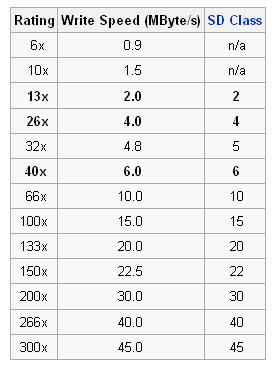
There are different speed grades available, measured the same as CD-ROMs, in multiples of 150 kB/s (1x = 150 kB/s). Basic cards transfer data up to six times (6x) the data rate of the standard CD-ROM speed (900 kB/s vs. 150 kB/s).
 
The maximum read speed and maximum write speed may be different. Maximum write speed typically is lower than maximum read speed. Some digital cameras require high-speed cards (write speed) to record video smoothly or capture multiple still photographs in rapid succession. This requires a certain sustained speed, or the video stops recording. For recording, a high maximum speed with a low sustained speed is no better than a low speed card. The 2.0 specification defines speeds up to 200x.
 
Some manufacturers use the read speed in their X-ratings, while others (Kingston, for example) use write speed.

sd class speed

SD Cards and SDHC Cards have Speed Class Ratings defined by the SD Association. The SD Speed Class Ratings specify the following minimum write speeds based on “the best fragmented state where no memory unit is occupied”:[9]
  • Class 2: 2 MByte/s – 13x
  • Class 4: 4 MByte/s – 26x
  • Class 6: 6 MByte/s – 40x
SD and SDHC cards will often also advertise a maximum speed (such as Continue Reading

45 Target CF Duplicator From Nexcopy – CF450PC

45 Target CF Duplicator From Nexcopy – CF450PC

Nexcopy Corporation released a new line of flash memory duplication systems, the CF Duplicator 150PC, 300PC and 450PC. These PC-based systems are designed for high-volume data loading to CompactFlash (CF) cards and bring serious throughput to industries still relying on CF for critical applications.

CF Duplicator

Nexcopy adds unique functions to make bulk data jobs less of a grind. For instance, the Unique Data Copy mode allows loading different files to each CF card during a single run—ideal for serialized content. Meanwhile, the Short Image Copy mode only writes data clusters in use, dramatically cutting copy times for partially filled cards. For Linux Ext2 or Ext3 file systems, the Full Image Copy mode ensures every byte is duplicated without question.

The CF Duplicator line is modular. Pricing starts at $1,200 for the 150PC, with clear upgrade paths to the 30-port and 45-port units. This approach gives organizations flexibility: start small, scale later. Nexcopy also allows mixing duplicator boxes, meaning operators can copy SD cards, CF cards, and USB flash drives—all at once, from the same software interface. That’s a big win for production teams juggling multiple formats.

Copy Modes Built In

The Drive Manager software offers six copy modes to cover nearly every workflow:

  • File Copy
  • File Copy Add
  • Image File Copy (.img)
  • Unique Data Streaming to each card
  • Device Copy – short
  • Device Copy – full

Product details: CF Duplicator by Nexcopy

Where CF Still Matters

CompactFlash isn’t as mainstream as it once was, but it remains essential in industries that need speed, durability, and consistent performance. Photographers and videographers continue to rely on CF for high-resolution image capture and 4K/8K video. Industrial and embedded systems lean on CF cards for rugged reliability in environments where shock, vibration, and extreme temperatures are everyday realities. In medical imaging and patient monitoring, CF storage provides a stable backbone for secure data logging. Even in niche sectors like gaming arcades and forensic labs, CF holds its ground as a dependable medium.

By pairing robust hardware with smart software, Nexcopy’s CF450PC helps these industries keep CF media viable, efficient, and protected. For organizations still living in the CompactFlash world, this duplicator isn’t just a nice-to-have—it’s the workhorse that keeps production running on time.

Source: GetUSB.info

Continue Reading

Compact Flash Uses Dual Processor For 90MB Sec Transfer Rate

dual processor CF cardYes, you read the title correct.  We now have a dual processor on Compact Flash cards.  The new SanDisk Extreme Pro clicks along at an impressive 90MB/s transfer rate. Just what the doctor ordered for the professional photographer and photo analysis equipment applications. So what does this mean for transfer rates?  Well consider a typical [high performance] CF card runs at 45MB/s write speed.  The new dual processor CF card runs [basically] twice as fast. Of course the device itself is only half the equation, you still need a host who can accept such fast speeds, such as the Canon EOS 7D or Nikon D300s dSLRs to name a few. For those who have the camera already, you might need the SanDisk Extreme Pro ExpressCard Adapter which plugs into the ExpressCard slot on laptops. Compared with typical card readers which offer up to 20MB/s transfer rates, the SanDisk adapter allows up to 90MB/s read and write speeds. The Extreme Compact Flash series is targeted at enthusiasts and available in 8GB (S$139 (US$99.43)), 16GB (S$269 (US$192.43)) and 32GB (S$399 (US$285.43)) capacities. For professional photographers who need fast, high-capacity media, the Extreme Pro comes in 16GB (S$413 (US$295.44)), 32GB (S$741 (US$530.08)) and 64GB (S$1,382 (US$988.63)) versions. The new cards are in retail stores now. Continue Reading

Compact Circular Card Reader

card readerElecom has a slick new card reader.  It’s compact in size and versatile in memory card support. Traditionally card readers are like flash drives, rectangular in shape with a little dress-up on the outside case.  Elcom’s is a creative twist. The circular card reader includes a magnet on the base so you can attach it to your 1970’s metal desk, or use it to pin up your kids latest drawing on the refrigerator door. The circular card reader is available in black, white, pink and lime green.  List price is $27 and ships directly from Japan. Continue Reading

Nexcopy Uses Movie Trailer Theme to Make Product Announcement

Nexcopy Uses Movie Trailer Theme to Make Product Announcement

Here is an interesting twist on how a company can introduce a product. Nexcopy leaned on the classic movie trailer theme to position its new 40-port and 60-port USB duplicators. The production quality of the video is excellent, and at just about a minute long, it gives you enough information to spark interest without dragging on.

The concept works because it mirrors what audiences already know: trailers tease, excite, and build anticipation. Nexcopy applies that same principle here to highlight a new line of high-capacity duplicators that aim to solve real workflow problems for IT managers, production houses, and service bureaus who need to move content quickly and reliably.

We’ve mentioned Nexcopy Inc. before for its flagship 20-port USB duplicator, as well as its SD duplicators and USB Copy Protection solutions. This latest marketing push shows the company isn’t just building new products but also rethinking how to reach customers in a more engaging way.

Continue Reading

Samsung Getting Into Retail Flash Memory Sales

For those who know, the Samsung branded NAND flash memory is considered the Tier 1 quality that everyone talks about.  It’s the best stuff out there…highest quality, best in performance, yet always a touch above others [Micron, Hynix, etc] in price.

Samsung flash

Well that might change because Samsung is entering the retail market with their solid state flash of Secure Digital, Compact Flash and microSD media. Samsung will release sizes from 4GB to 16GB capacity before the end of 2009.  These cards will be in the ‘Plus’ memory card class and compliant with the Secure Digital class 6 performance standards.  Cards boust a speed range of 17Mbps to 45Mbps. Continue Reading

Intel, Micron With 3-bit Cell Technology

Intel and Micron are two of the primary NAND flash memory makers and are partners in such manufacturing.  Earlier this month they announced new technology capable of 3-bit per cell storage which is based off 34-nanometer technology.

3-bit cell technology

The 3-bit per cell concept allows for more storage in the same realestat of flash memory.  This imporvement yields larger storage capacity of flash drives and SSD at a lower price. However, the new technology doesn’t come without some draw backs.  According to Kevin Kilbuck, Director of NAND marketing at Micron indicates the 3-bit per cell technology isn’t as stable as they’d like. For example, Kevin indicates the 3-bit per cell NAND technology will be found in less mission critical devices like USB flash drives, SD memory and CF memory.  The technology will not find it’s way into SolidState Disks until the manufacturing process is perfected.
“The companies explained that they need more experience in production volumes before they will be confident to position it as a chip suitable for the high-write environment of the SSD”
You can expect the 3-bit per cell to hit the streets sometime in Q1 of 2010. However, as with most technology, it’s on the way out before it’s ever even in; SanDisk and Toshiba disclosed in February that they had developed 4-bit-per-cell technology, which the two companies said was the highest-capacity flash memory technology in the industry. Continue Reading

Copyright © 2011-2019 by
USB Powered Gadgets and more…
All rights reserved.

SD Card Duplicator Equipment

GetFlashMemory.info has reviewed SD Card Duplicators by Nexcopy.  Our results found the product to be reliable, fast and accurate.

They manufacture both PC connected and standalone systems to fit any type application

Turn your product into a custom USB shape. Right down to the last detail. Click to see over 30 examples of custom shape USB drives.

Twitter One

Twitter Four