
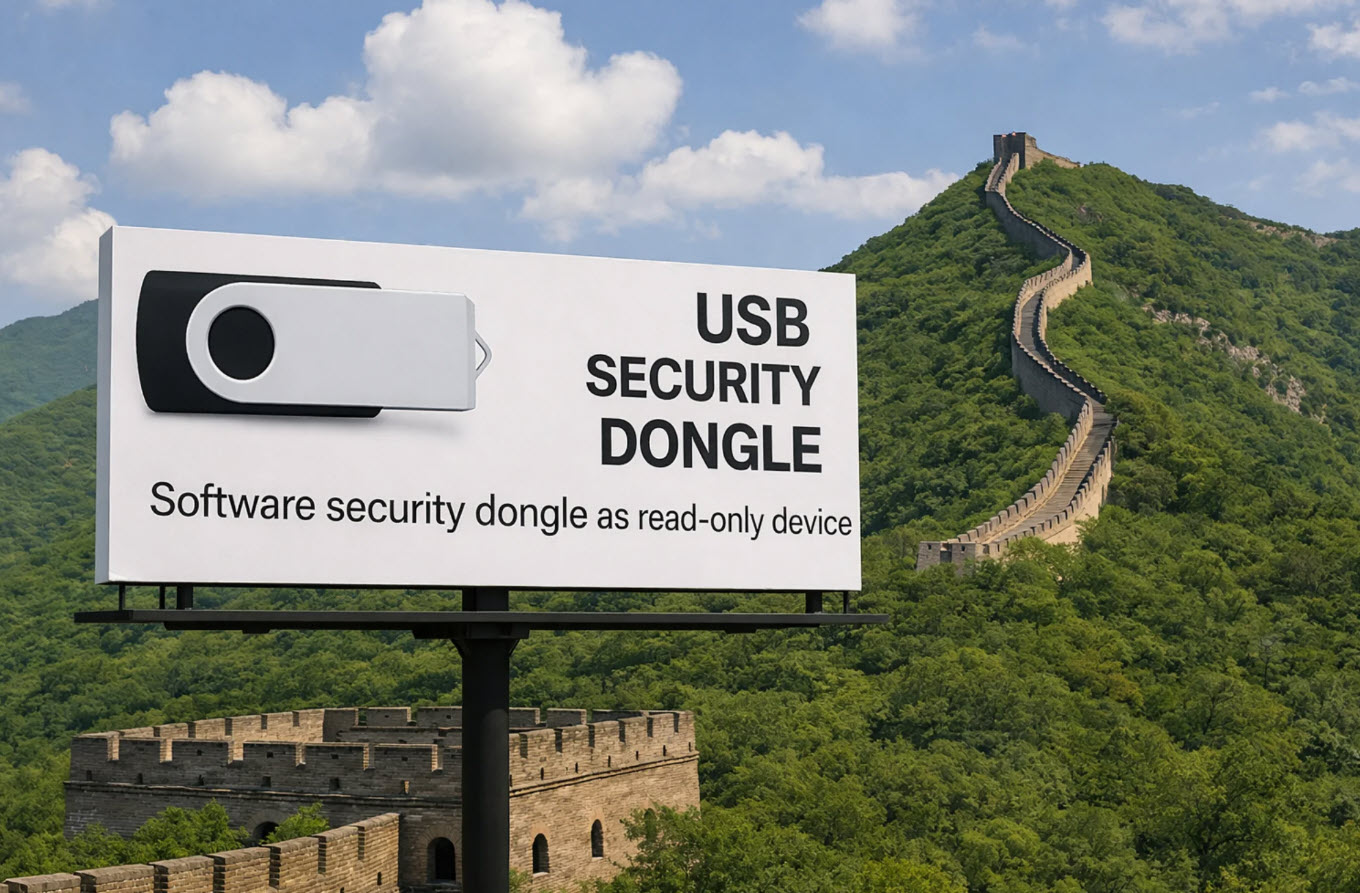
USB software dongles didn’t disappear – they moved into the environments where cloud licensing stops being dependable
That hardware dongles are obsolete is one of those ideas that sounds true if your whole frame of reference is SaaS, browser-based licensing, and systems that assume a permanent connection to something upstream. But once you step into controlled environments, secure networks, isolated labs, or industrial systems where a failed license check can shut down a perfectly functional workflow, that assumption falls apart in a hurry.
This perspective builds on an earlier editorial from GetUSB, which called the shift correctly. The cloud did not eliminate hardware dongles. It simply forced them into the places where physical control, predictable behavior, and independence from outside services still matter.
Cloud licensing solved convenience, but introduced fragility
Cloud licensing works very well when every layer underneath it is stable. That is the part people like. It is easy to provision, easy to update, and easy to manage from a distance. But what gets glossed over is that the license check is no longer a simple local event. It becomes a chain of dependencies tied to connectivity, authentication endpoints, certificates, policies, account state, and time synchronization. The software may be fine, the workstation may be fine, and the operator may be ready to work, yet access still fails because something external decided not to cooperate.
That is exactly why hardware-based licensing remains common in environments where uptime matters more than convenience. Air-gapped defense systems, laboratory instruments, secure engineering networks, and industrial control deployments do not care how elegant the cloud looks on a product page. They care whether the system starts when it is supposed to start. In those settings, removing outside dependency is not old-fashioned thinking. It is risk control.
The cloud did not replace dongles. It exposed where the cloud itself becomes the weak point.
The traditional dongle model never changed very much
What is interesting is not that dongles survived. It is that most traditional dongles stayed architecturally the same while deployment models around them evolved. Companies such as Thales with Sentinel and Wibu-Systems with CodeMeter built serious ecosystems around hardware authentication, and those ecosystems remain proven for good reason. They are mature, deeply integrated, and trusted in places where software protection has to be enforceable.
But the underlying pattern is familiar. A dedicated chip answers an authentication request, the application validates the response, and the software decides whether to proceed. That model works, but it comes with baggage. It typically means SDK integration, runtime support, and a tighter dependency on the vendor’s development path. The dongle becomes a single-purpose object whose job is to answer one question – is this license valid?
That made sense when software delivery and software enforcement were treated as separate problems. It makes less sense when the USB device itself is often part of the deployment method.
The shift is subtle, but it changes what the device actually does
What is changing now is not the need for hardware enforcement. What is changing is the role of the device inside that enforcement model. Nexcopy’s approach is different because it does not treat the USB device as a passive token alone. It treats the device as a controlled storage environment, which is a much more interesting idea once you understand the implications.
Instead of simply validating access at the application layer, the device participates in what happens to the data from the moment it is connected. It can be configured around controller-level behavior, read-only states, partition rules, and usage control in a way that moves enforcement closer to the hardware itself. That is a different posture than the old challenge-response model because the device is no longer just proving identity. It is helping define behavior.
That is a better fit for real-world USB workflows, where the same physical device often carries software, content, updates, or controlled material that must be distributed while also being protected.
Storage and enforcement are starting to converge
Traditional dongles separate delivery from validation. One piece of hardware says the user is allowed in. Something else handles the actual content or software package. But when the USB device itself becomes the delivery medium, that separation starts to look inefficient.
What makes the device-level model worth paying attention to is that storage and enforcement begin to converge. The same medium can carry the application or data set while also defining what the host system is allowed to do with it. That reduces some integration burden in certain deployment cases, simplifies how controlled media is distributed, and shifts security policy closer to the controller layer rather than leaving everything to software hooks and external checks.
That does not mean encryption goes away, and it does not mean traditional licensing stacks become irrelevant. It means there is now a more practical middle ground for deployments that need control without dragging in an entire cloud or entitlement framework.
Different models solve different problems
There is no reason to pretend one approach replaces the other. Traditional dongle ecosystems are still the right answer where centralized entitlement management, floating licenses, and deep application integration are required. Those platforms were built for that job and they continue to do it well.
But device-level USB enforcement fits a different category of need. Controlled media distribution, offline validation, simplified deployment, and environments where the physical device is part of the workflow all benefit from this model. These are not fringe use cases. They are simply less visible to people who think software distribution begins and ends with a login screen.
The real change is moving from license validation to hardware control
For years, the dongle category was defined by one narrow question – can this key prove the software is authorized? That is still important, but it is no longer the whole conversation.
The more relevant question now is what the device allows once it is attached. What can be read, what can be copied, what can be modified, and what is locked down before the operating system or application layer ever gets involved. That is a broader and more useful model of enforcement because it reflects how USB hardware is actually used in the field.
That is why hardware dongles did not die. They matured into a narrower, more serious role. And in that role, they may be more relevant now than they were when everyone assumed the cloud was going to replace them entirely.