
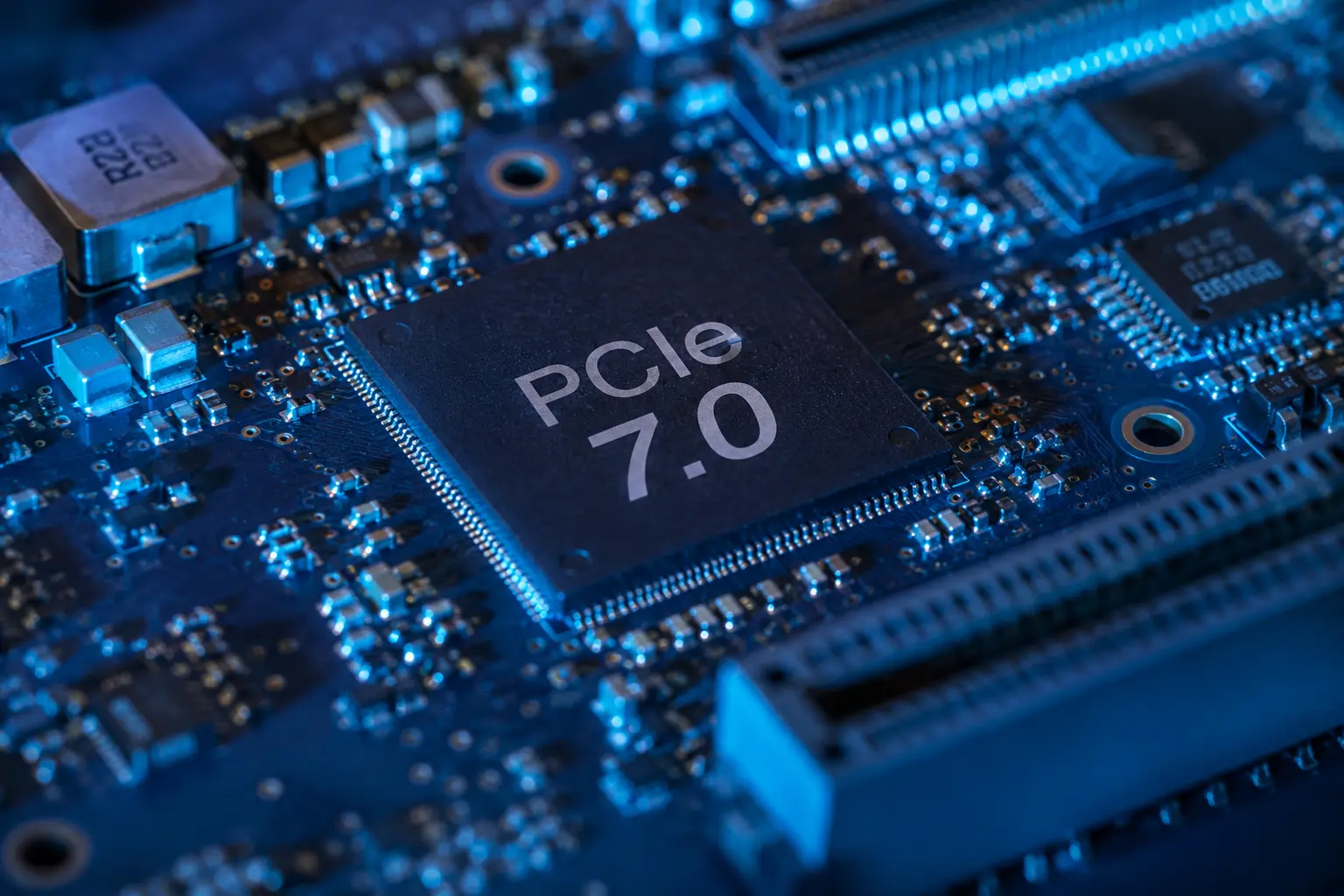
Silicon Motion, better known throughout the storage industry as SMI, has already started discussing its direction for PCIe Gen7 SSD controllers. At first glance, that sounds early. PCIe Gen5 products are still working their way into broader use, while PCIe Gen6 storage has not yet reached the mainstream. However, SMI’s move toward Gen7 is exactly what makes the announcement worth examining.
The important part is not simply that PCIe Gen7 will be faster. Every new PCIe generation brings another increase in available bandwidth. The more interesting question is what must change inside the SSD controller to make that bandwidth useful.
As the interface becomes faster, the controller has less room for hesitation. It must retrieve data from NAND, correct errors, organize commands, manage cache, balance flash channels, and complete background maintenance without allowing the PCIe connection to sit idle. That is why the next stage of SSD controller development is increasingly focused on Quality of Service and better scheduling rather than peak speed alone.
More Bandwidth Moves the Bottleneck
PCIe Gen7 is expected to provide 128 GT/s per lane. In an x4 configuration commonly used by NVMe SSDs, the interface could support more than 50 GB per second of practical bandwidth after protocol overhead is considered.
That number will look impressive on product specifications, but the interface is only one section of the storage path. Data must still be retrieved from multiple NAND dies, processed by the controller, checked by error-correction hardware, moved through cache, and delivered in the correct order.
Increasing PCIe bandwidth therefore does not automatically produce a proportional increase in SSD performance. Instead, it shifts the bottleneck deeper into the drive. The controller must coordinate more work in less time, and any scheduling weakness becomes easier to expose.
A useful comparison is a freeway that has been expanded from four lanes to eight. The road can theoretically carry more traffic, but the extra lanes do not solve congestion if every vehicle is directed toward the same exit. The system still needs an effective way to control where traffic goes and which traffic moves first.
That is increasingly the role of the SSD controller.
Why Quality of Service Matters
SSD marketing has traditionally focused on maximum sequential read and write speeds. Those figures remain useful, but they describe performance under favorable conditions. They do not necessarily show how consistently the drive responds when many operations are competing for the same internal resources.
Quality of Service, usually shortened to QoS, measures that consistency. Instead of asking only how fast an SSD can complete its best transaction, QoS examines how predictably the drive completes requests across a much larger workload.
An SSD can produce an excellent average response time while still experiencing occasional latency spikes. A command may be delayed because a NAND channel is busy, the controller is performing garbage collection, an error-correction operation requires additional processing, or data must be moved before another write can continue.
Those delayed commands are sometimes described as long-tail latency. They represent the relatively small percentage of transactions that take much longer than the average. As PCIe bandwidth increases, these outliers become more important because a small number of delayed commands can prevent the host from using the interface efficiently.
This is why a drive with slightly lower peak bandwidth may perform better in a sustained workload if it delivers tighter and more predictable response times. The system spends less time waiting for an unusually slow operation, even when the benchmark headline is not quite as dramatic.
For PCIe Gen7 controllers, QoS becomes a central design problem. The controller must deliver very high throughput while also preventing maintenance tasks, NAND behavior, and queue congestion from creating unpredictable pauses.
Better Scheduling Inside the SSD
Improving QoS requires better scheduling throughout the controller.
Modern SSD firmware must decide which command should be completed next, which NAND channel should receive the request, whether a read should be prioritized over a write, and whether a background operation should be delayed until the workload becomes less demanding.
The controller is also responsible for garbage collection, wear leveling, cache flushing, error correction, and the replacement of unreliable blocks. These operations are necessary because of how 3D NAND flash memory stores and manages data, but they can interrupt host requests if they occur at the wrong moment.
Erase behavior is another example. NAND cannot simply overwrite existing data in place. Blocks must be prepared and erased before they can be reused, which is why NAND flash erase speed still matters even when the interface itself is capable of moving data at extraordinary rates.
Better scheduling allows the controller to perform this necessary maintenance while minimizing its effect on active commands. The objective is not simply to complete as many operations as possible. The objective is to complete them in an order that keeps latency controlled, distributes work across available resources, and avoids internal congestion.
This turns firmware into a major part of SSD performance. Two drives may use similar NAND components and the same PCIe generation, yet behave very differently because one controller manages queues, maintenance, and flash resources more effectively.
Why SMI’s Gen7 Direction Matters
Silicon Motion’s early work on PCIe Gen7 is significant because controller development must begin long before finished SSD products reach the market. By the time a new interface becomes commercially relevant, the architecture, firmware strategy, error-correction system, and scheduling model must already be well developed.
SMI is not simply preparing a faster version of an existing controller. The company is preparing for an environment where interface bandwidth will expose every delay elsewhere in the storage path. That requires a controller built around stronger QoS, more intelligent scheduling, and tighter coordination between the host interface and the NAND behind it.
This is the larger technology shift behind PCIe Gen7. The interface speed will receive most of the attention, but the controller will determine how much of that speed becomes usable performance.
The Controller Becomes the Differentiator
PCIe Gen7 will push SSD bandwidth to another level, but bandwidth alone will not define the best drives. The more important differences may be found in how consistently each controller responds, how well it schedules competing operations, and how effectively its firmware manages the physical limitations of NAND flash.
Silicon Motion’s decision to move in this direction provides the reason for looking at the technology now. The Gen7 interface may still be years away from broad deployment, but the controller architecture required to support it cannot be developed at the last minute.
Future SSD competition will still include higher sequential speeds, but the strongest controllers will be the ones capable of sustaining those speeds without allowing latency, maintenance, or internal congestion to disrupt the workload. PCIe Gen7 raises the ceiling. Better controller design will determine how close an SSD can actually get to it.
GetFlashMemory.info provides independent commentary and technical analysis covering NAND flash, SSD controllers, storage interfaces, and the broader memory industry.