Flash Memory – Where Did It Start

So here is a bit of information one could use for a cocktail conversation starter at your next computer club meeting, the start of flash memory.

The first piece of flash memory was invented way back in 1984.   Flash was invented by Toshiba and by a guy named Dr. Fujio Masuoka.   According to Toshiba records, the term “flash” was suggested by Dr. Masuoka’s colleague, Mr. Shoji Ariizumi because the erase process of the memory contents reminded him of a flash like in a camera.

Toshiba presented the new invention at the IEEE 1984 Integrated Electronics Devices Meeting in San Jose California and Intel saw the immediate value and jumped on board.   By 1988 the first commercial NOR type flash chip was commercially available.

NAND flash Toshiba

NOR based flash has long erase and write times and has a full address/ data interface.   Meaning one can read or write data to any portion of the NOR chip.   The NOR technology is mostly used for low levels of read/write cycles.   So for example, NOR is great for BIOS and firmware of a device.   NOR was the first version of flash, but everyone quickly realized a cheaper, faster solution is also needed.

In 1989 the first NAND flash chip was introduced.   It had faster erase and write times, higher density, and lower cost than NOR flash – with ten times the endurance. The draw back with NAND [if you can call it that] is the I/O interface only allowing sequential access to data. Meaning you can only write to the device after the last bit of data has been written.   This makes it suitable for mass-storage devices such as PC cards and various memory cards like USB, SD and microSD, and somewhat less useful for computer memory.

As flash memory technology grew quickly in the earily 2000s, the growth enabled the development of USB flash drives to what we more commenly see today: compact, portable devices with unique body shapes, colors, styles and features. The USB flash drive, also known as a thumb drive or pendrive, was first brought to market in 2000 and has since grown into an inexpe nsive gadget nearly every computer owner has.

The invention is commonly attributed to an Israeli company, M-Systems, founded by Dov Moran. Along with engineers Amir Ban and Oron Ogdan, M-Systems filed the patent for the USB-based flash storage device in April 1999. Their product, known as the “DiskOnKey,” became the first commercially available USB flash drive.

At about the same time a Singapore-based Trek 2000 International launched its version of a USB flash drive, called the “ThumbDrive,” also in 2000. The company, led by Henn Tan, claimed independent invention and holds several patents related to its design.

One final player in the discussion about “where did flash memory start” is Pua Khein-Seng of Phison Electronics in Taiwan who is credited with creating the first single-chip USB flash controller, which dramatically reduced the cost and size of flash drives, helping pave the way for mass adoption.

Today, USB flash drives are ubiquitous and owe their success to the rapid advancement of NAND flash and the global contributions from innovators in Israel, Singapore, and Taiwan.

Continue Reading

3 Bit Per Cell NAND Flash

3 bit per cell3 bit-per-cell NAND is sampled out the manufacturers.  The 3 bit per cell is exactly that, 3 bits of information are stored in each NAND cell.  This increased the capacity while keeping the foot print the same size.  This ultimately leads to larger storage capacity at a cheaper price.  Traditionally, SLC [Single Layer Cell] and MLC [Multi Layer Cell] technology is used is USB and SD flash, but we will begin to see TLC [Triple Layer Cell or 3 bit per cell] technology have a full roll-out by the end of this year. Over the past 18 months the biggest problem with TLC is the stability of the memory and performance, but Intel and Micron feel they overcame those problems and ready for production.  More with their press release: Continue Reading

Recover File From Compact Flash Card

If you need to recover files from a Compact Flash card then try Flash Memory Toolkit.  This software package is a free download for most features and will perform functions like read/write benchmark tests and recover files from a flash card or flash drive.

recover file, Compact flash card

USBPerformance software will allow you to recover a file from a Compact Flash card.  This is how it works. The utility will make a binary image of your Compact Flash card…it doesn’t matter if you can’t read the data or not, it’ll still make an image file. Then the utility will mount the image file as a drive letter on your computer [PC only]. From here you can browse your content and recover that file from your Compact Flash card. In most cases, when a flash card goes bad [either CF, SD, microSD or USB] the problem or error is from the partition table or the File Allocation Table.  Since this mounting of an image gets past those issues, you can get into where the files are stored…from here you can copy them out to a normal working part of your hard drive or another removable media. Give it a go.  USB Performance website with a link directly to the file recovery page. Continue Reading

USB 3.0 Chipsets to boost Genesys and Alcor Revenues

AlcorIC design houses Genesys Logic and Alcor Micro are expected to see their revenues grow over 20% sequentially in the second quarter of 2010 buoyed by increasing shipments of USB 3.0 controller chips, according to industry sources. Genesys indicated that it has started shipping, in small volume, its second-generation USB 3.0-SATA bridge controllers, with the third-generation of its kind to be available in the third quarter of 2010. Overall, USB 3.0 chips will contribute over 3% to its total revenues in the second half. Meanwhile, industry sources indicated that Alcor Micro has landed orders for USB card reader controllers for LCD TV application from a major player in Korea, which will help drive up its USB controller shipments. Continue Reading
Connect Any USB Device To Your Cell Phone

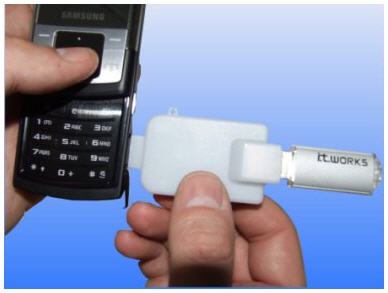
Elan is launching an adapter to connect any USB stick to your mobile device via the microSD slot.

mobidapter elan

Elan is a UK based company who developed the “Mobidapter” for mobile power users.  The connector does not require drivers and will allow any USB device to be seen by the mobile host.  Further, the Mobidapter doesn’t require a PC, so important tasks like backup, sync or accessing files will be much easier. Unfortunately, there is no word on price and expected ship date is mid June 2009. Continue Reading

Review: 16GB USB Flash Drives

Review of 16GB Flash Drives

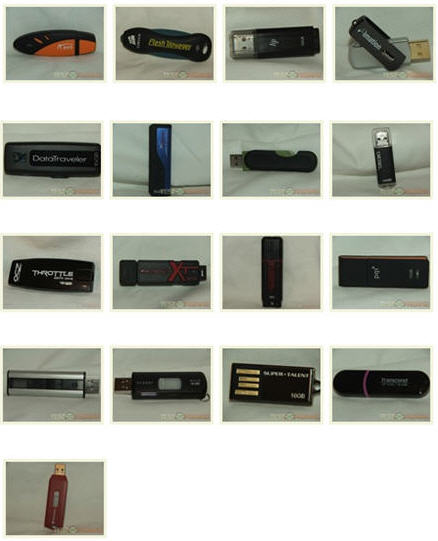
GetUSB.info posted a review article about 16GB USB flash drives.  The benchmarking and testing was done by Test Freaks.  Test Freaks is a website based specifically on review and testing of everyday technology so users can make an informed decision about their technology purchases.  The review of 16GB flash drives is very in-depth and detailed so depending on what you look for in a flash drive, this review will have it summed up nicely for you. The 16GB USB review includes the following drives:
  • Adata Sport Series RB19 16gb
  • Corsair Flash Voyager
  • HP USB Flash Drive v125W
  • Imation Swivel Flash Drive
  • Kingston Data Traveler100
  • Kingston DataTraveler HyperX
  • Memorex Traveldrive
  • OCZ Diesel
  • OCZ Throttle
  • Patriot Exporter XT
  • PNY Attache
  • PQI Traveling Disk 1221
  • Ridata EZdrive Lightning Series
  • Sandisk Cruzer Micro
  • Super Talent Pico-C
  • Transcend JetFlash Elite Enabled
  • Verbatim Store ‘n’ Go

review 16GB USB drives

I wont give away the full details on the 16GB USB review – please check with Test Freaks. However, it is painfully clear that Transcend Jetflash is a horrible drive. Which is funny as they spend a good amount of marketing time and money saying they are the best performing. Transcend must be taking Ford’s marketing philosophy and advertising their weakness. “Built Ford Tough” ha – those cars are anything but tough. To get a bit of their approach Test Freaks considers:
…diskbench is nice in that it tells us the actual times and transfer rates to complete the tasks of Copy To or Write To the USB drives, Read From and Copy From as well. I run these three tests on my USB drives because they are the most common things people are going to be doing with their USB drives.  First up is testing with the 350MB .AVI Video file, lower scores are better as they are shown in seconds. The first test is for Copy To or Write To the USB drives.
For the full 16GB USB Drive review please visit Test Freaks webpage. Thanks Anton. Continue Reading

USB Duplicator is 20 Target Time Saver

Nexcopy’s 20-Target USB Duplicator Delivers Speed and Efficiency for IT Teams

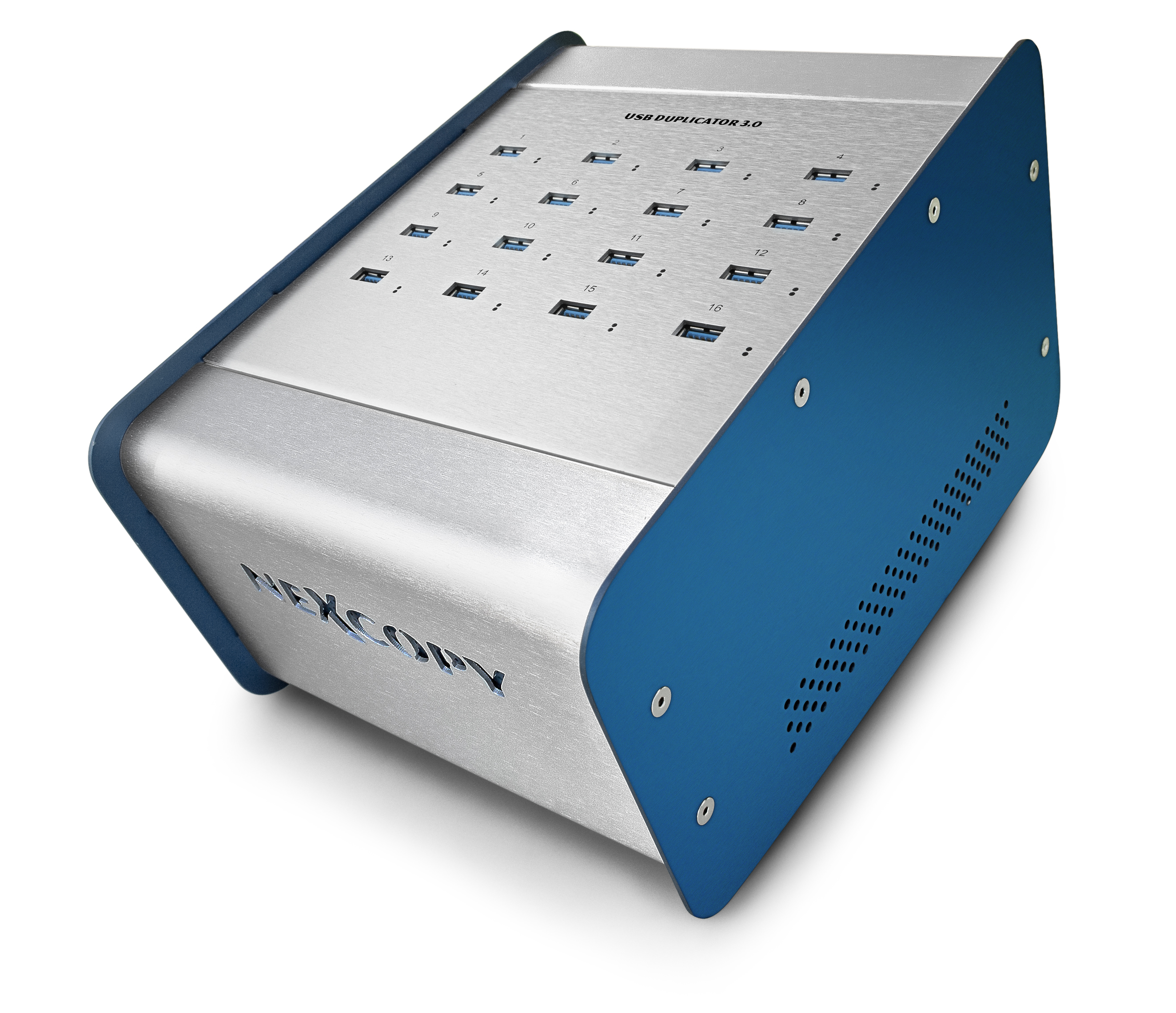
We’ve heard of a USB port replicator which is a fancy word for dock station, but now we have a USB Duplicator from Nexcopy. The USB duplicator is the largest PC-based copier on the market which quickly and easily copies data to flash drives. The average user wouldn’t need this, but this product would be a great fit for many corporations today. Since USB flash memory is such a popular medium for data distribution, the USB duplicator seems like a good investment that would save an IT team a significant amount of time.

USB duplicator with 20 target slots

The Nexcopy USB Duplicator has several different functions like file copy, which copies files and folders from a PC onto the flash drive with the same file structure. Another feature is USB device copy. This is a low-level duplicator with a bit-for-bit copy function. The USB200PC also comes with a Copy Job function so you can set a string of activity such as Format, Copy, Verify, and Volume Name.

The USB Duplicator is powered by Windows PC software written and owned by Nexcopy called Drive Manager. This software suite does a variety of things besides duplication, such as data extraction (reading files off the USB flash drive), unique data streaming to put unique content on each flash drive, formatting, erasing, and making image files of your masters.

Software features for Nexcopy’s USB Duplicator system

  • File Copy
  • Copy Add
  • Data Stream
  • Device Copy – short
  • Device Copy – full
  • Image Copy (.img file)

File Copy

Point the Drive Manager software to any folder on the host computer and everything will be copied over. This is very similar to the drag-and-drop function in Microsoft Windows. Note that Drive Manager runs only on Windows.

Copy Add

With any targets formatted as FAT, FAT32, exFAT, or NTFS, the software can add files to USB sticks which already have data on them. This is a useful feature for large datasets where only a small portion of new content needs to be added.

Data Stream

Use this feature to stream unique data to each flash drive. This is ideal for publishers and medical companies that require bulk loading where each USB stick needs different information. The unique data streaming feature supports both static and dynamic content.

Device Copy – short

Drive Manager uses a binary bit-by-bit copy from a physical master to all connected targets. This includes the MBR (Master Boot Record), partition table, and content. The “short” copy function will only duplicate data clusters detected on the master. For example, if a 64GB flash drive has only 5GB of data, the short function will copy only 5GB instead of the entire 64GB.

Device Copy – full

Using the same bit-by-bit copy method, the full Device Copy function duplicates the entire master to all targets. This is typically required when the master uses a file system Windows cannot read (such as Linux ext3 or ext4) or a proprietary format.

Image Copy (.img file)

Use a digital master file to duplicate content to USB flash drives. By using an image file, you get the same bit-by-bit duplication process without requiring a physical master.

The Nexcopy duplicator has a list price of $1,299, making it the most economical solution for the number of targets it provides: 20.

Source: GetUSB.info.

Continue Reading

Copyright © 2011-2019 by
USB Powered Gadgets and more…
All rights reserved.

SD Card Duplicator Equipment

GetFlashMemory.info has reviewed SD Card Duplicators by Nexcopy.  Our results found the product to be reliable, fast and accurate.

They manufacture both PC connected and standalone systems to fit any type application

Turn your product into a custom USB shape. Right down to the last detail. Click to see over 30 examples of custom shape USB drives.

Twitter One

Twitter Four