Why Is My SD Card Write Protected?

Understanding Why Your SD Card Shows a Write Protect Error

I ran into a situation the other day where my SD card was suddenly write protected. I couldn’t format it, I couldn’t delete the files, and I certainly couldn’t write to it. I checked the lock/unlock switch and still, no luck. I thought the card was a total loss.

It turns out, the SD card wasn’t the problem — the card reader was.

After some internet searching I found several solutions to the problem, but no one really explained what the issue was. So I thought others could benefit from understanding why their SD card is showing a write protect error.

First off, let’s take a look at the SD card reader itself. Below is a typical SD connector found inside most readers. The area to pay attention to is the part of the reader that makes a physical connection to either give write access or enforce write protection. It’s the thin metal strip the blue arrow is pointing to.

internal SD card reader mechanism

What gives the SD card a write protect error is when that metal strip does not make contact with another strip inside the reader. When the card is pushed into the slot, the internal metal piece should bend outward and touch the outer strip shown above. That contact is what enables write access.

To give you a better idea, here is a rough schematic of the connectors:

SD card write protect schematic

The internal piece has a slight angle so when the SD card is inserted, it gets pushed outward to make contact with the outer piece. This shorts the circuit and provides access to the card. Here’s another example illustration:
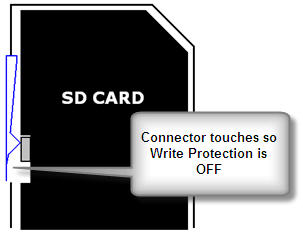
SD write protect mechanism example

The problem occurs when those two metal pieces fail to connect. Typically, the internal strip gets damaged when the card is forced in too hard or too fast. Damage may cause the angled piece to bend flat or push deeper into the reader.

Here are a couple of solutions to resolve the write protect error:

1) Use tape on the SD card. Place a small piece of tape on the side where the lock/unlock switch is. This extra thickness usually pushes the internal strip outward enough to restore contact with the outer strip. It’s the easiest solution since it doesn’t require opening the reader.

2) Super-glue the strips together. For a more permanent fix, you can gently push the internal strip outward with a pin or paperclip, then glue it to the outer piece. A drop of liquid super-glue works well with metal. This ensures contact is always made.
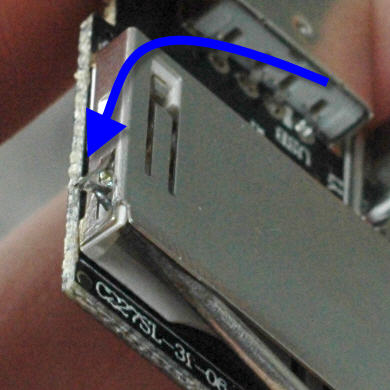
SD card reader metal strip repair

If the internal strip has been pushed too far back or damaged beyond repair, tape and glue might not help. At that point, replacing the reader is the best option. Thankfully, they’re inexpensive.

The takeaway here is that your SD flash memory itself usually isn’t write protected — it’s the reader mechanism causing the error. Don’t throw away a perfectly good SD card. Try one of these fixes first and you’ll likely solve the issue.

Side note: If your goal is to intentionally set write protection on an SD card, this must be done at the device level. A card reader doesn’t control this. To truly create a write protected SD card, a vendor command has to be sent to the card’s controller to block write operations. Specialized equipment, such as Nexcopy’s SD Card Duplicator, can perform this task.

Continue Reading

Surplus of NAND Flash Memory To Continue

DRAMeXchange published a market research paper stating that NAND flash memory will continue to flood the market at lower prices. NAND flash memory is primarily used for storing songs, photos and other data on gadget type devices like digital cameras, MP3 players and iPods. The biggest contributing factor on why the market will continue to see cheap NAND is lack of sales.

sandisk flash memory

Since production forecasts run months ahead, the market has sitting inventory. To move this inventory prices are continueing to drop. For example, DRAMeXchange reported a drop of 20% in June for NAND memory related devices.
The NAND flash market has been so bad that the creator of the chips, SanDisk, on Monday reported a surprise loss of US$68 million for the second quarter. The company blamed the supply glut for its problems, pointing out that it sold a record amount of flash, 120 percent more than the same time last year, but that prices are down 55 percent compared to then.
SanDisk also reported the flash memory pricing might get worse [better for us] in the third quarter. So, it might be a good idea to start picking out your Christmas items now and make sure it’s some type of flash gadget. On the flip side, with today’s surplus means these companies are cutting back production as well, so once this flood dries up, we could see a shortage for NAND and prices jumping up…and the cycle goes on. Source: Network World. Continue Reading

Flash Memory Market Not Yet Saturated

kingston ceoDespite many industry players believing both the memory card and USB drive markets are saturated, Kingston Technology company president John Tu recently said substantial business potential still exists. Citing average monthly shipments of 20 million units for both memory cards and USB drives, Tu said the huge shipments imply that these markets are still growing. He thinks memory cards and USB drives serve as a “platform” for consumers to interact with different kinds of content. While many people think memory device makers should pay digital content providers in order to add content to their products, Tu said it should be the providers paying Kingston to distribute content via its well-established sales network, brand and market share. He added in saying that shipments of both memory cards and USB drives are set to expand further in the future. However, Kingston remains cautious about solid-state drives (SSDs). Tu stressed that the company will only tap into segments it is certain will grow, but once it extends a presence, it will produce in big volumes in order to grab a large share of the market quickly. Kingston believes this is the business strategy it is good at. He recalled the deployment in NAND flash as an example, saying that Kingston only made its decision when the market proved to have substantial potential. Source + Photo: Digital Times. Continue Reading
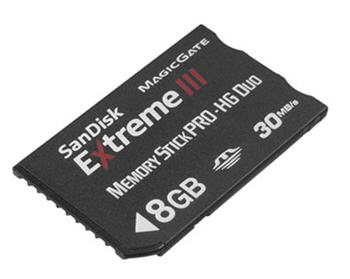
New Sony Memory Stick Is Faster Than Fast

SanDisk is going faster than fast with their new Memory Stick PRO-HG Duo product.  This new Memory Stick line from SanDisk is the fastest format of it’s kind.  So what kind of speed are we talking about?  How about 30MBs per second.  Yep, MBs not Mbts per second.  The sustained transfer speed for both reading and writing is static at 30MBs and it’ll be interesting to see if the spec is the same as the street [experience].

memory stick pro-hg

To put this figure in perspective, the non-HG Extreme III Memory Stick from SanDisk is only able to achieve an 18MBps transfer speed. This new memory card represents an increase of over 50%.
If you want to put that into perspective, check out a dated benchmark from a couple years ago.  Boy how times have changed. The SanDisk Sony Memory Stick PRO-HG Duo is expected to become available late next month with 4GB and 8GB sizes at prices between $90 and $150 respectively. Source:  MobileMag.com. Continue Reading

SATA Flash Module From Transcend

Transcend continues their effort into the embedded systems applications with their most recent announcement of the SATA Flash Module. The high-speed SATA flash modules specifically designed for use in thin clients, blade servers, ultra-compact sub-notebooks and space-limited industrial installations allows Transcend to offer up their lightweight and compact SATA flash memory modules.

sata flash module

With solid-state flash memory being non-volatile and more robust than spinning hard disk solutions, it makes the SATA flash module ideal for harsher environments with more demanding applications, such as embedded systems, medial instruments, factory automation equipment, network infrastructure and other industrial equipment. What I like most about flash memory modules is the low power consumption, shock and vibration resistance, longer data retention durability and instant access time (no spin up or seek times we traditionally see in HHDs). Transcend’s SATA flash modules are offered in 1GB and 2GB capacities, in both vertical and horizontal versions to satisfy industrial application requirements. Continue Reading

Flash Memory Prices Will Continue To Fall (What’s New?)

I have my reasons for watching the flash memory market.  One of the key elements I look for is falling flash memory prices.  For me, dropping memory prices’ is an indicator other activities I’m in will continue to grow.  Today I read an interesting article which gave some great detail about the continued drop of flash memory. I’ll start off with a quote to the article, then you can click through for more:
Prices of NAND flash memory could plummet this year because of weak demand and an oversupply of NAND flash in the market, analysts said on Wednesday. If concerns about the U.S. economy deepen, consumers may reduce spending on the phones and other devices that use NAND flash, weakening demand for the chips and depressing prices, said Nam Hyung Kim, director and chief memory analyst for iSuppli. He predicted that prices could fall by as much as 55 percent this year. Up to 90 percent of NAND flash is sold as storage for MP3 players and cell phones, or as cards such as the MicroSD that are slotted into digital cameras and other devices. The reduced price for flash could lead to cheaper products for consumers. Apple already dropped the price of its 1G-byte iPod Shuffle this week, to US$49 from $79, partly because of the falling prices of flash memory, said Shaw Wu, an analyst with American Technology Research.
More. Continue Reading

Low Density NAND Flash Memory Stays Strong for 2008

Silicon Motion

While forecasting strong sales and profitability in 2008, Silicon Motion projects that demand for low-density NAND flash will beat that for the high-density segment, driven by demand for microSD cards and embedded memory, said company president and CEO Wallace Kou.
Silicon Motion guides that annual sales will grow by 25-35% on year with gross margins to stay in the range of 52-53% in 2008. Although memory makers strive to migrate NAND flash applications to higher density under sales and profitability concerns, that makes no difference for controller makers, Kou said. For a controller IC design house, he stressed that memory density has no relationship on controller sales, given that any NAND flash application (such as USB drive or memory card) only requires one controller, regardless of memory density.
In light of global economic trends, Kou said demand for low-density NAND flash products should be better, partially due to sales spurred by the bundling of memory cards with handsets. Demand for microSD cards will continue to expand in 2008, Kuo said. Out of the 96.3 million units of controllers shipped in the fourth quarter, 89.3 million were for memory cards and USB drives, he detailed. Continue Reading

New 12GB microSDHC is 50% Storage Boost

12gb microsdhc sandisk cardSanDisk announced today a massive 12GB microSDHC card which is 50% larger in storage capacity than it’s previous model (8GB). So what does this mean?  It means our mobile devices are getting one step closer to becoming a storage medium for all sorts of data, phone related or not.  From MP3 files, video and data files … with 12GB of flash memory, quit a lot can fit.  To put things into perspective, the microSDHC can hold [about] 1,500 MP3 songs, 3,600 photos and 24.5 hours of video. If you haven’t used or seen a microSDHC card, make sure you stop off at your local computer store and take a look.  The size is incredibly small.  About the size of your pinky fingernail. Some background info:  The SDHC format applies to SD flash memory which is larger than 2GB is storage space.  The new 12GB microSDHC card conforms to the SD 2.00 specification and has the theoretical maximum storage capacity of 32GB. On a closing note, the new SanDisk microSDHC card has a transfer speed compatible with the Class 4 specification.  Too geeky for ya – let me sum it up: Continue Reading

Underwater Video Diving Mask with microSD Slot

So you drop $1,200 on a Nikon digital SLR camera, buy vacation airline tickets to Hawaii and now want a water tight case for underwater picture taking.  Well, save that large roll of cash and purchase the Liquid Image, 5 megapixel underwater scuba mask.  Slap in some microSD memory and you’re set for more pictures than your air tanks can hold.

microsd scube mask

New this year at CES is the Liquid Image underwater scuba mask.  The small digital lens/camera can take still pictures or record video at VGA quality with either a 5 MP or 3.1 MP lens.  The $99 price point is for the 5 MP version. Take a close look at the diagram above and you’ll see a AAA battery pack, small storage area, shutter select option, cross hairs for centering and position of the lens along with microSD port & USB port for storing additional images or downloading what you have to PC. The underwater scuba mask does look bulky but I personally think this is a great alternative to underwater cameras.

underwater mask with microsd

Underwater Video Scuba Mask product page. Continue Reading

All Flash Memory Sony mini VAIO

The Sony Mini VAIO is getting a flash memory upgrade to 32GB which means (obviously) more storage, but more importantly faster boot times and energy savings as flash memory takes less power then a spinning disk hard drive.
flash memory mini vaio sony
Some other shinning features of the Sony Mini VAIO are wireless LAN & WAN, 4.5inch touch-screen, sliding keyboard and Windows Vista Basic. As being the first flash memory based VAIO the price tag comes in just at $2,500 USD – WOW. Continue Reading

Copyright © 2011-2019 by
USB Powered Gadgets and more…
All rights reserved.

SD Card Duplicator Equipment

GetFlashMemory.info has reviewed SD Card Duplicators by Nexcopy.  Our results found the product to be reliable, fast and accurate.

They manufacture both PC connected and standalone systems to fit any type application

Turn your product into a custom USB shape. Right down to the last detail. Click to see over 30 examples of custom shape USB drives.

Twitter One

Twitter Four